
Technical Tuesday: UiPath IXP and the reinvention of stream document processing
Technical Tuesday: UiPath IXP and the reinvention of stream document processing

Summarize:
The paperless office was supposed to arrive in the 1970s. It didn't. Half a century later, most enterprises still run on PDFs, scanned forms, email attachments, and the eternal Invoice_FINAL_v2_ACTUALLY_USE_THIS_ONE.pdf.
Documents aren't going anywhere. What's changing is their role inside enterprise processes, and what production-grade stream document processing (continuous, high-volume document ingestion) has to do to keep up.
In our last post, we argued that IDP isn't being replaced; it's evolving. This one goes under the hood.
Why documents are still the bottleneck
In the old intelligent document processing (IDP) world, every document was an island. A PDF arrived, a model extracted fields, the output went downstream, and the document's useful life ended there. Agentic processes don't work that way. A loan package, a claim file, a medical record feeds a document-to-decision pipeline where evidence, context, and prior extractions become part of the organization's working knowledge.
That raises the bar for stream document processing: the continuous ingestion, classification, and extraction of information from high-volume, varied sources in real or near-real time. Sources shift, schemas drift, and the system has to adapt without losing the governance properties that made IDP deployable: reliable accuracy, auditable evidence, lifecycle control. Customers want higher straight-through processing (STP) at lower cost, faster integration into workflows, and a defensible path through local and global compliance regimes.
UiPath IXP (Intelligent Xtraction & Processing) is how we think about meeting that bar.
The two dimensions of document complexity
Enterprise document complexity has two dimensions worth separating.
The first is document entropy. Schema entropy is the variability of field structures and their relationships: how twenty vendors encode the same invoice, how one payer's explanation of benefits differs from another, how a contract's clauses shift across jurisdictions. Semantic entropy is the ambiguity of meaning itself. The same phrase, interpreted differently depending on context, policy, or downstream use.

The second is operational constraints. Jurisdictional rules on where a document can be processed. Data residency requirements. Acceptable error rates per field. Cost profiles that have to hold across millions of pages a month.
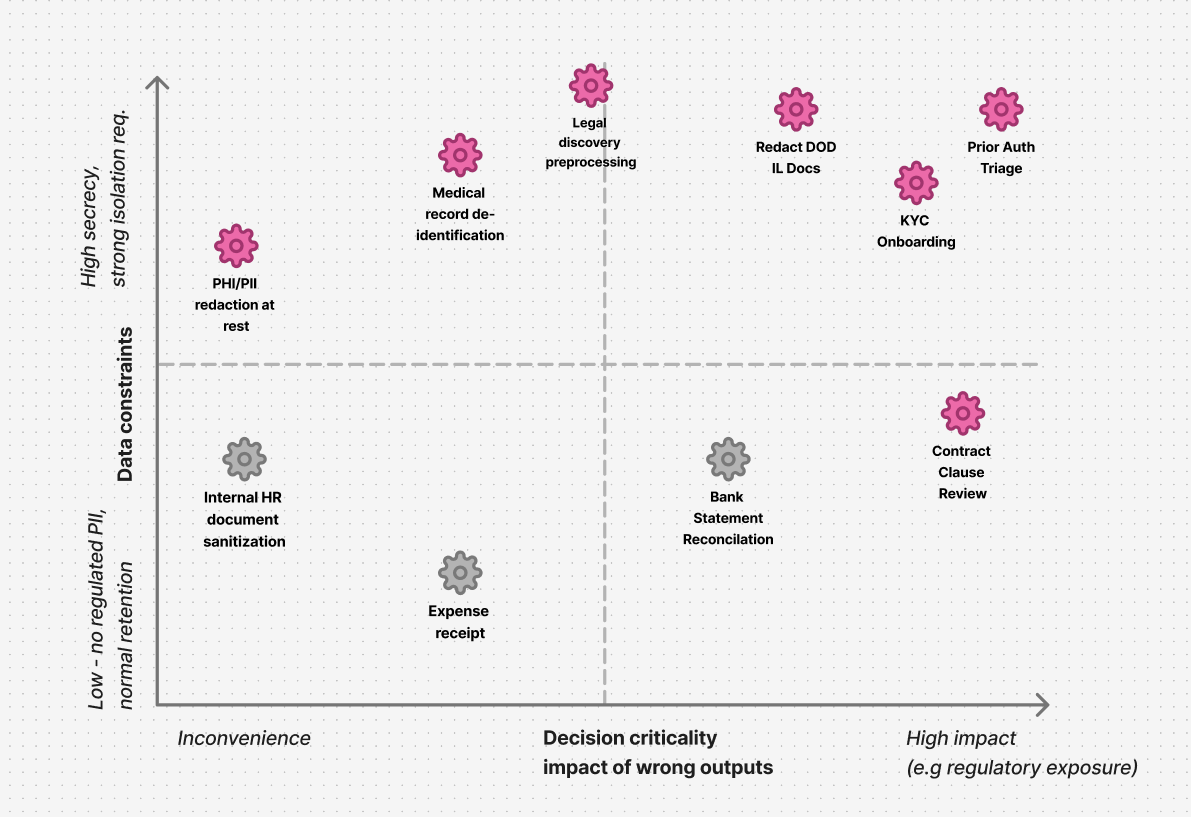
Most IDP programs fail on the second dimension. The team optimized extraction accuracy and skipped the harder work of making the pipeline operable in context. A high-accuracy model that cannot run in the right region, or cannot produce an audit record, is a non-starter. A compliant pipeline that cannot absorb schema drift across a vendor onboarding is a rebuild waiting to happen.
Taxonomy as a contract
UiPath IXP reduces entropy through taxonomy. A taxonomy defines the fields, types, relationships, and validation rules a document class is expected to produce. It functions as a contract between extraction and the systems downstream.
That contract is the governance spine. Schemas change under version control. When a new vendor variant appears, the taxonomy is extended, not rebuilt. Workflows, agents, and systems of record bind against stable field names and types, rather than against whatever the model happened to emit today.
IXP can auto-generate taxonomies from sample documents, compressing what used to be weeks of schema discovery into hours. Agentic approaches to extraction still depend on this layer. Production reliability requires schema validation, evidence capture, and fallbacks, regardless of how capable the underlying model is. "The model said so" isn't a governance strategy.
Risk-stratified processing
A fifty-page medical record and a ten-dollar coffee receipt should not travel the same pipeline. In medical record summarization, critical facts like medications, allergies, and lab values run through strictly verified extraction with evidence capture and field-level traceability. Lower-risk narrative content like progress notes can use OCR plus lighter LLM cleanup.
Compliance sets the floor: the minimum verification, isolation, redaction, and retention controls a document class must meet. Cost and downstream use determine the ceiling. The result is a portfolio of pipelines, each tuned to a risk class, each producing the same shape of auditable record so reviewers see consistent evidence regardless of which path a document took.
From clerk to judge
The most interesting shift is in the human role.
In a traditional IDP operation, people did clerical work. They retyped values, corrected misreads, and resolved exceptions by looking things up themselves. They rebuilt answers from scratch, which was slow, expensive, and error-prone in its own way.
In IXP, a pre-validation agent operates as a digital senior clerk. It reasons through ambiguity, consults external tools (an ERP, a CRM, a system of record), proposes corrections, and captures its reasoning as evidence. By the time a person sees the document, the hard work has been done: a candidate answer, a second-opinion check against policy, and a trail showing how both were produced.
The human becomes a judge. They adjudicate proposed fixes against evidence and policy rather than rebuilding the record themselves. That's where STP gains compound, and where auditability gets stronger, because every decision carries the reasoning that led to it.
Validation as composable primitives, governable by design
A monolithic validation UI fights how agentic processes actually run: across ERPs, case management, email, chat, and internal tools.
Validation Station in UiPath IXP is being delivered as embeddable primitives. A lightweight SDK and modular components let teams integrate validation into the surfaces where users already work, including through MCP apps and elicitation patterns. Policy enforcement, evidence capture, and audit behavior stay consistent everywhere, because they're properties of the primitive, not the host application. UiPath Maestro coordinates the long-running orchestration without fragmenting the audit record. The same policy, evidence schema, and audit format follow the document wherever validation happens.
What this unlocks
Documents are no longer islands. They're inputs to policy-bound, auditable, composable pipelines that feed agents, systems of record, and ultimately decisions. UiPath IXP, working alongside orchestration layers like UiPath Maestro™, is how those pipelines become governable: deployable inside the compliance regime you actually operate in, past the proof of concept stage.
The next wave of automation value is in document-to-decision workflows that are fast enough to compete, accurate enough to trust, and disciplined enough to survive an audit. That's the bar IXP is built to clear. If your current document stack can't meet all three at once, that's the conversation to have next.

Product Manager, UiPath
Related articles


Get articles from automation experts in your inbox
Sign up today and we'll email you the newest articles every week.
Thank you for subscribing!
Thank you for subscribing! Each week, we'll send the best automation blog posts straight to your inbox.
Get articles from automation experts in your inbox
Sign up today and we'll email you the newest articles every week.
Thank you for subscribing!
Thank you for subscribing! Each week, we'll send the best automation blog posts straight to your inbox.